
13 Ways to Get Your Summer Thrills in Tasmania
Make the most of the longer days this summer with adrenaline-fueled adventures and nature-rich experiences, right on your doorstep.

The unseen victims of the “fast fashion” industry are the people exploited in the manufacture of cheap clothing. Trisha Striker wants to make sure none of us look the other way.
The overwhelming majority of people would agree that modern slavery and the exploitation of people is wrong. This problem, however, is so deeply entrenched in so many things we consume, that it can feel impossible to do anything about it.
University of Tasmania staff member and student Trisha Striker has made it her mission in life to change that, and she believes universities are perfectly placed to initiate change.
Her work to raise awareness of the slavery and exploitation of people – particularly in the clothing and fashion industry – earned her a Highly Commended nomination in the 2023 Green Gown Awards (Sustainability Champion – Student category), which recognises sustainability efforts in the tertiary education sector.
Last year, Trisha completed her Undergraduate Certificate in Sustainable Living at the University of Tasmania, which helped her expand her knowledge and hone her communication skills around sustainability issues.
But her determination to shine a spotlight on the issue of modern slavery stretches back much further. In fact, she can recall one specific moment overseas, as a seven-year-old, that lit the spark.
“I was confronted with the reality of a young person around my age, experiencing what we would now call ‘the worst forms of child labour’,” Trisha said.
“The stark disparity between us hit me. We were a similar age, but our lives were so different. Did they go to school? Where did they sleep at night? What did they do for fun? Seeing another human being’s suffering in such close proximity impacted me deeply. My whole journey since then has been about people.”
Relocating to Australia as a teenager, Trisha finished high school in Queensland and eventually found herself in Townsville. In 2015 she began a Bachelor of Business (Economics) at James Cook University, hoping it would give her a broader understanding of the systemic context behind inequality and injustice in the world.
But the framework of economics wasn’t enough to answer the deeper questions she was asking.
“I would constantly bother the lecturers and tutors with a myriad of questions, and they encouraged me to ask the dean of the college for permission to study extra electives, from outside of economics, to investigate my ideas.”
Those additional electives took Trisha to Germany and Slovenia, where she explored the ways different countries in Europe worked to reconcile their turbulent histories with their current complex economic and social situations, to create more inclusive, fair and sustainable societies.
In 2016, Trisha presented a TEDx talk titled The High Cost of Cheap Clothing discussing modern slavery in the clothing and fashion industry. It has been viewed almost 60,000 times on YouTube.
In recent years, there has been increasing pressure on the “fast fashion” industry to take responsibility for the huge amounts of synthetic fabric waste created by discarded clothing. But the exploitation of those who manufacture the clothing is frequently an inconvenient truth, one consumers try not to think about: child labour, sweatshops, and exploited workers who are underpaid, or not paid at all.
The TEDx talk led Trisha to create a project urging James Cook University to investigate the possible risk of slavery and exploitation of people in the university’s supply chains, and to explicitly include “justice and people” in the university’s sustainability commitment.
“This project made a case for ethical procurement at James Cook University and initiated the creation of a Social Procurement Framework, which they still use today.”
By the time Trisha completed her Business/Economics degree in 2019, she realised that slavery and exploitation of people was not just the outcome of one factor, but rather something that occurred at the intersection of many other issues: profit-oriented business, consumer culture, marketing, injustice, environment, poverty, gender inequality, food insecurity, climate change, development and sustainability.
In 2020, living in Hobart, a friend suggested studying Sustainable Living at the University of Tasmania, and Trisha loved the course.
“It provided an opportunity to understand the interconnectedness of slavery and other issues through a more holistic sustainability lens,” she said.
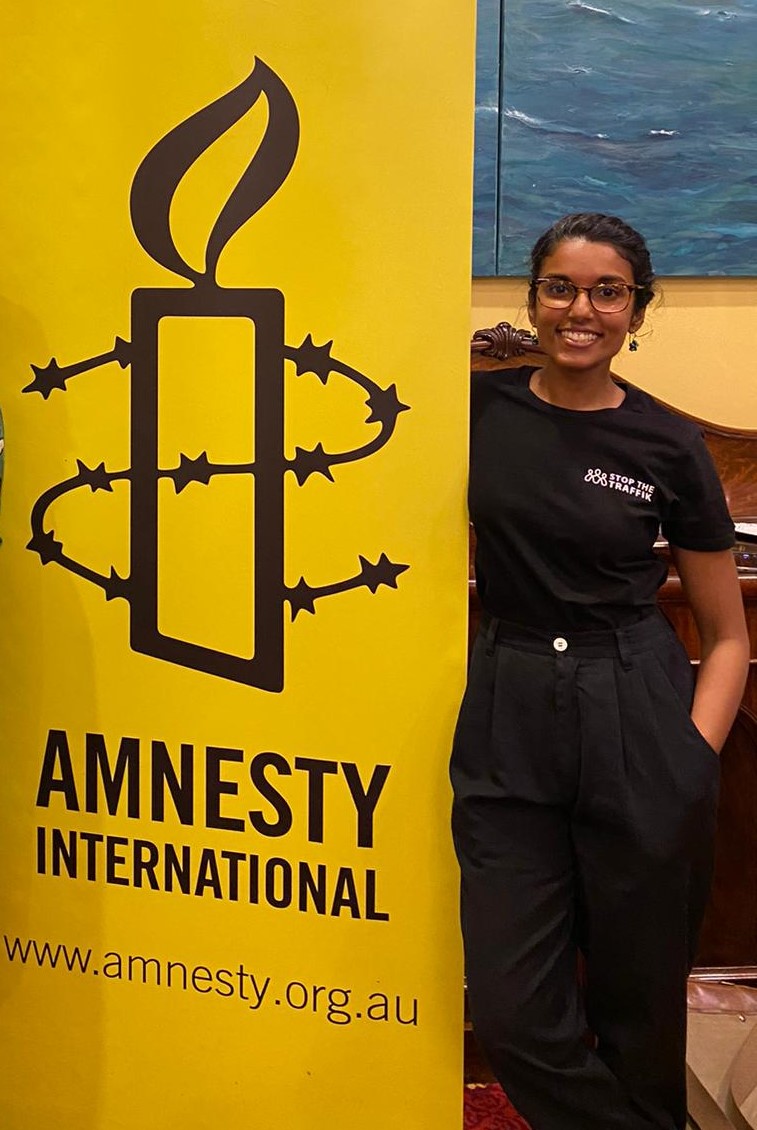
“People tend to focus on the environmental side of sustainability, forgetting that the social aspects are just as important. I also met some amazing people who taught me some much-needed lessons for advocacy.
“Communicating Sustainability was my first subject, a topic that I’d not considered. It led me to think about how the language used to discuss sustainability can itself become a barrier to understanding.
“People are the solution to this issue, and we need to invite people to take part in whatever ways they can.”
Trisha also completed an internship and fellowship with the University’s Sustainability Integration Program for Students (SIPS). The internship gave her the opportunity to work with various people across the University to create a plan for sustainable procurement and, this time, pitch it to the University of Tasmania.
“I investigated the risk of slavery and exploitation in the University’s clothing and apparel supply chains and evaluated the effectiveness of Fairtrade certification to reduce this risk and contribute to other sustainability goals.”
She presented her findings to the University’s Marketing, Procurement and Sustainability teams, students, academics, and the student association (TUSA). As a result, the University asked its apparel supplier to start stocking Fairtrade certified products, a change that made sustainable products available to all its clients, reaching well beyond just the University’s own operations.
“Universities combined represent millions of dollars in procurement. This aggregated buying power can influence industry supply chains and make things different for everyone.”
Trisha continues to work tirelessly in a range of roles and projects to try and create a more sustainable and equitable future, including co-founding the Freedom Polos Project (FPP), which assists Tasmanian schools in procuring Fairtrade certified, organic cotton school uniforms.
Recently, Trisha has begun a Bachelor of Philosophy at the University of Tasmania to further understand the people-side of the issue and to contribute to real, lasting, transformational change.
“Throughout this whole journey, I had this niggling feeling that I needed to come back to basics – respect, compassion, justice, fairness and equality,” she said.
“No matter how much I talked about frameworks, policy and procedures, real change has to come from the heart. Seeing the humanity in that young person transformed me, I did not want to participate in a system that benefitted me by harming others.
“For me, human connection and partnership is crucial to ending injustice and imagining a fairer and more just world, so the problem doesn’t feel far away or abstract.
“As a friend of mine said a few years ago, ‘proximity is the enemy of prejudice’.”
What is Modern Slavery?
While not defined in law, the United Nations uses “modern slavery” as an umbrella term covering practices such as forced labour, debt bondage, forced marriage, and human trafficking.
Essentially, it refers to situations of exploitation that a person cannot refuse or leave because of threats, violence, coercion, deception, and/or abuse of power.
This can include the practice of underpaid and unpaid labour and child labour in the clothing industry.

Stay up to date with everything happening at the Hobart Magazine.