
13 Ways to Get Your Summer Thrills in Tasmania
Make the most of the longer days this summer with adrenaline-fueled adventures and nature-rich experiences, right on your doorstep.
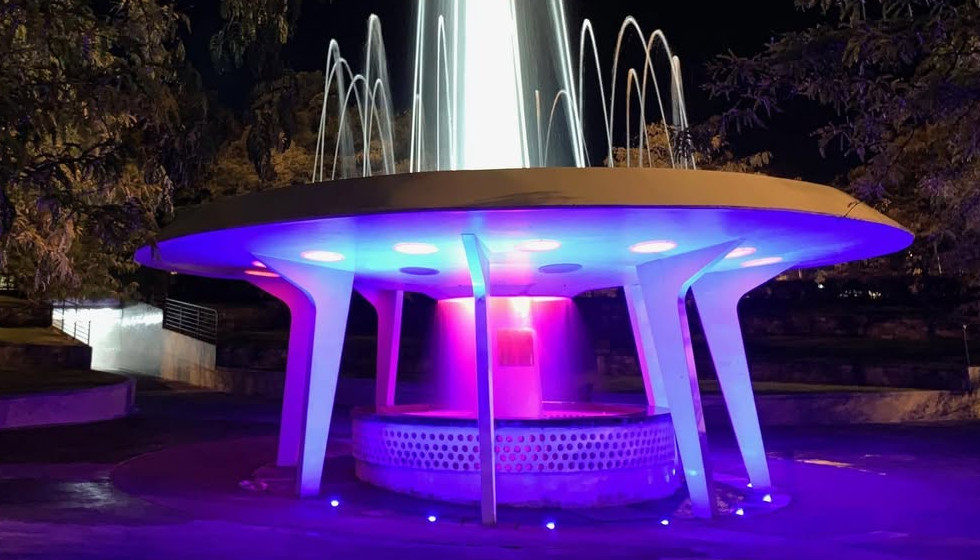
In the postwar decades, the world looked to the stars and so did its architects. Inspired by the atomic age, the space race, and the optimism of a technologically advanced future, a new aesthetic emerged called Googie architecture (not to be confused with Google). This style is identified by upswept roofs, neon signage, flying saucers, and curves. Picture The Jetsons and you’re most of the way there.
While Googie architecture is typically associated with the sun-drenched highways of California, where it shows up in motels, coffee shops and petrol stations, its influence reached some surprising places, including here in Tasmania.
The most prominent example of Googie architecture in Tasmania is the Railway Roundabout, which marks the entrance to Hobart along the Brooker Highway. More than just a traffic circle, it features a striking fountain design and neatly landscaped gardens that helps it stand out.
In the early 1960s, a national competition was held for the roundabout’s design. The winning concept came from Cadbury in Hobart, and it had nothing to do with chocolate. The structure was completed in 1962 before officially opening in 1963. And wouldn’t you know, its design draws heavily on space-age Googie influences.
As you drive around it, the fountain gives the impression of a UFO having landed, thanks to its bowl shape, jet-fin pillars, circular detailing underneath, and a pointed spire. This effect is amplified at night, when it’s lit up with coloured lights and beams that highlight its UFO-ness. The fountain includes 92 coloured lights, 120 jets, and a modern wind-speed monitoring system to control water spray and help keep pedestrians dry.
Here are some fun facts. It’s called the Railway Roundabout because the nearby ABC building stands on the former site of the Hobart railway station, which provided passenger train services to Hobart’s northern suburbs. Subways on two sides allow pedestrians to access the fountain and surrounding park. In 2015, it was named the world’s best roundabout by the UK’s Roundabout Appreciation Society, which honours a different roundabout each year from around the world.
And now for the less cheerful fact: in recent years, the roundabout has become a known black spot for traffic accidents. Between 2004 and 2014, independent data modelling based on government statistics recorded more than 1,700 car crashes at the site.
The Railway Roundabout isn’t the only space-age-looking landmark along the Brooker Highway, as just a little further north is the Glenorchy Arch. The bright yellow structure beside the highway at Rosetta is instantly recognisable, with its four arches meeting at a central point. It almost resembles an extraterrestrial four-fingered hand touching down to Earth, each arch adorned with wire and circular discs.
The Arch has royal origins as it was constructed in 1954 by local businesses to honour Queen Elizabeth II’s visit to Hobart. Originally, it featured a crown perched on top and a “Glenorchy” sign suspended from the centre, but the whereabouts of both are a mystery. It was once on the highway before being relocated to Glenorchy’s Riverfront Motel (then known as the Motel Derwent) in 1960, where it has remained ever since. It was dismantled in 2021 as part of a restoration project, and is currently resting comfortably on site, awaiting inspection. The Glenorchy Arch is another rare example of Googie architecture in Tasmania, and possibly the only commemorative arch of its kind still standing in Australia.
It’s interesting to consider how such a distinctly American architectural style found its way to Tasmania, albeit in a small amount. In the 1950s and ’60s, Tasmania was experiencing rapid growth and development. With that came a sense of optimism about the future, perhaps not unlike the feeling in postwar America. In a way, it’s not surprising that some of the ideas and aesthetics of the space age also took root here.

DON’T FORGET THE ROCKET PARK
Another space-age-inspired site is ANZAC Park in Ulverstone. Known locally as the Rocket Park, it features a unique red and yellow rocket ship and a flying saucer-shaped structure. These pieces of play equipment have been in place since the 1970s and both included slides. However, due to safety concerns they were removed. Today, the flying saucer serves as a barbecue shelter, while the rocket is a “look but don’t touch”. The future of these Ulverstone icons are currently uncertain. In May this year, the Central Coast Council sought community feedback on what should happen to the structures. Throughout June and July, the Council will review submissions, with a final decision expected in August. Locals were invited to vote on whether to repair the existing rocket or replace it with a new design.

Stay up to date with everything happening at the Hobart Magazine.