The Hobart

Trippy Skippy and the Crop Circle Mystery

by Hobart Magazine
Trippy Skippy and the Crop Circle Mystery

Tasmania is no stranger to weirdness, so it’s appropriate we have our very own crop circle mystery.

These Tasmanian crop circles didn’t appear on corn or wheat. Rather, they showed up on poppy fields. There are thousands of acres of these fields here, because Tasmania produces almost half of the world’s opium poppy supply. These crops are legal and grown for medicinal purposes. Poppies contain valuable alkaloid material that’s used for pain relief, including morphine, thebaine and codeine, and Tasmania is a hotspot due to ideal climate conditions.

It’s not known when the circles first appeared. Poppy farming started in Tasmania in the 1960s, but it wasn’t until 2009 that this story broke out. Basically, poppy growers were waking up on misty Tassie mornings to discover their farms covered with crop circles.

Imagine what it must’ve been like to discover them. You’d probably be annoyed about the damage to your crop before the questions started creeping in. What on (or off) earth caused this?

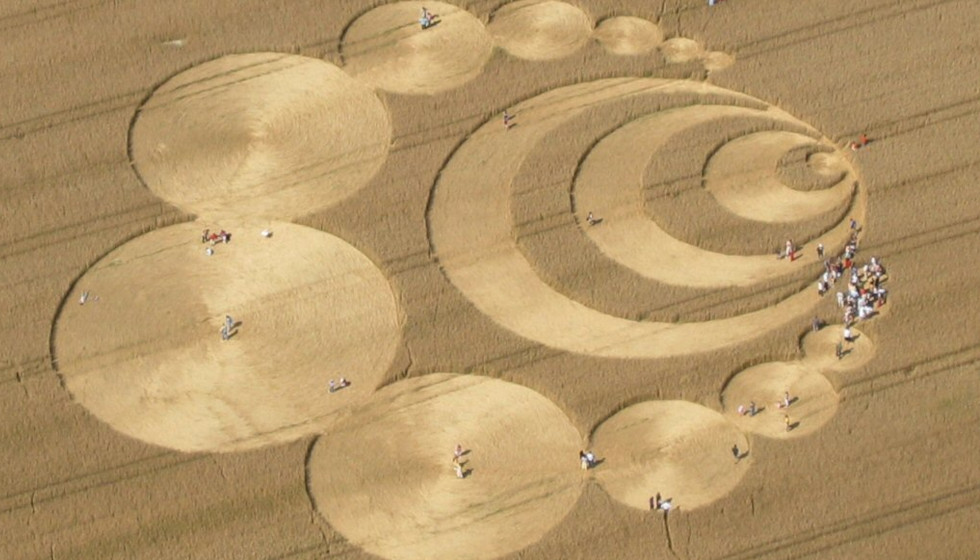
For most, the first thing to come to mind might be aliens. That’s what pop culture has taught us. Crop circles are large, sometimes intricate, patterns created by flattened crops that look like a spaceship had landed there. In actual fact, humans are the ones most cases can be attributed to. In 1991, two hoaxers, Doug Bower and Dave Chorley, took credit for having created over 200 crop circles throughout England. After this was widely reported, copycats started creating more all over the world.

But these Tasmanian crop circles are different. They were not caused by humans. It would’ve been difficult to do, since poppy fields are well protected, with ‘keep out’ signs plastered over fences saying trespassers will be prosecuted and the illegal use of the crop may cause death.

So, some aliens that wanted a free high, then? Not that either. In 2009, it was revealed the culprit behind the crop circles were in fact…wallabies!

Bennett’s wallabies to be specific. They’re medium-sized marsupials common to eastern Australia and Tasmania. If you’re driving around the bush at night, it’s most likely these guys you’re spotting on the side of the road.

These cheeky wallabies had been sneaking under the fences, snacking on the poppies, then getting a high, which caused them to hop around in circles, trampling the crops and creating the crop circles.

It might sound like a joke, but this news was revealed when Tasmania’s attorney- general at the time, Lara Giddings (who later became premier of Tasmania), stood before parliament for a budget hearing. She said, “We have a problem with wallabies entering poppy fields, getting as high as a kite and going around in circles.” Not an ordinary budget hearing by any means. “Then they crash,” said Giddings. “We see crop circles in the poppy industry from wallabies that are high.”

Giddings was answering questions about the security of Tasmania’s poppy stocks. Needless to say, this bombshell captured media attention, and news sites all over the world reported on the security-breaching, high-chasing marsupials.

At this time, Richard “Rick” Rockliff (the father of Jeremy Rockliff, current premier of Tasmania), was field operations manager for Tasmania’s largest corporate grower of opium poppies, Tasmanian Alkaloids, now known as Extractas Bioscience. Rick revealed it wasn’t just wallabies that were getting in on the action. He said deer and sheep that munched the poppies had been known to “act weird” afterwards. “There have been many stories about sheep that have eaten some of the poppies after harvesting and they all walk around in circles,” Rockliff told the media.

Retired farmer Lyndley Chopping had spent more than 30 years growing poppies and would see wallabies acting strangely in his fields. “They would just come and eat some poppies and they would go away,” he told ABC News in 2009. “They’d come back again and they would do their circle work in the paddock.”

So there you have it, the surprising culprit behind the Tasmanian crop circle mystery of ‘09. We’ll never look at wallabies the same way again.


Oui Oui Wallaby Believe it or not, that’s not the only weird and wonderful wallaby story out there. There’s a colony of them, about 150, who have emigrated to an unexpected place: France. Sacre bleu! The Tasmanian wallabies live in forests surrounding a French village called Émancé after escaping from a zoo in the 1970s. They escaped by burrowing through holes in the fencing, similar to their poppy escapades back home. The wallabies thrive to this day because of France’s similar climate to us, plenty of shelter, an abundance of food, and lack of predators. In 2003, yellow signs of a wallaby silhouette were installed. Now, they have become a mascot for the town, and residents still have a hard time convincing their friends that they’ve seen kangaroo-looking things on the side of the road.

Love this

Related Articles
Share

Close
13 Ways to Get Your Summer Thrills in Tasmania
Make the most of the longer days this summer with adrenaline-fueled adventures and nature-rich experiences, right on your doorstep.
Arve Falls Lookout
Feeling stifled from long days of mask-wearing? Luckily, in Tasmania we are never far from somewhere beautiful to escape to on our days off – and breathe in lungfuls of restorative fresh air, mask-free.
27 Hobart Friends Get Snipping For One Off Wine
The borders were declared shut in Tasmania on the 30th of March, 2020; the first stare to do so amid the COVID- 19 pandemic and hard lockdown of Hobart followed.
Danphe Nepalese and Indian Food + Peppermint Bay Bar and Bistro
Nepalese food is a comfort in our house. Having spent much time trekking and mountain climbing in Nepal as a younger man, Nepalese food is something I always love to go back to.
That’s DR Hannah Gadsby To You
From Smithton to Netflix and the Emmys stage, Tasmanian stand up comic Hannah Gadsby has forged an unlikely path. Following on from the massive success of her shows Nanette and Douglas, Hannah brings her new show Body of Work to Hobart this month.
PODCAST: Incat founder Robert Clifford on why electric boats are the future
Robert Clifford is the founder of Incat, a Hobart company building fast ferries for the world. Always looking to future opportunities, he has identified where Hobart sits in the next wave of transportation. For more of this interview listen to The Hobart Magazine podcast.
Is Tourism Ready For More Forestry Wars?
Tasmanian forests are special. They’re home to centuries-old trees, including the tallest flowering trees on the planet, and support unique native species. Yet not everyone agrees on how these forests should be managed.
Hobart Chefs: When The Obsession Becomes Real
Tasmania’s brand as a foodie haven is cemented. But within the local hospitality industry there are those who love to use local produce...and those who are next-level obsessed with it. We spoke to a bunch of Hobart chefs who are top of the game when it comes to fostering relationships with local farmers and growers.
Did You Know Australia’s First Female Doctor Was Hobartian?
Tasmania, despite its small size and population in comparison to the mainland, has produced more than its proportionally predicted percentage of significant figures and heroes of Australian history. 
Return Travellers Adding Pressure to Hobart Housing
For all of us 2020 was a year like no other, punctuated by rapid change and plenty of new challenges. For vulnerable people in Tasmania, including people facing homelessness, those on low incomes and those facing increasingly higher rents, it was very challenging. We are seeing a growing demand for homes in Tassie from international travellers returning home, people moving for work and others seeking the lifestyle that our Apple Isle has to offer.
Magazine
AboutContributeAdvertiseNewsletter Sign UpContact
June 2026

Stay up to date with everything happening at the Hobart Magazine.

Worker shortage is currently universal, there isn’t an industry that’s exempt. For Kelvin Smith, four years ago he decided there was a very obvious solution to the shortage facing the construction industry, and all that was needed was a little time, empathy and a helping hand. Integrate Workforce is a Hobart-based labour company with one requirement: a refugee/ migrant background. He’s also the outdoor piano man in his free time.

Landscape artist and creative Elliott Nimmo is enjoying discovering Hobart’s vibrant art scene and local environment after relocating here from London to pursue his art.

Even though Tasmania is known for its mild summers, it doesn’t take much to get sunburnt. Tasmania experiences extreme ultraviolet (UV) levels, but contrary to popular belief this isn’t due to the hole in the ozone layer, which is actually south of the continent.While higher UV levels often occur at the same time as higher temperatures, the two are not linked. Instead, UV levels are determined by the angle of the sun in the sky: the higher the sun, the higher the UV. In December and January, the position of the sun over Tasmania gives the state a UV index of 11 or more on most days, which is classified as “extreme” on the UV index. Tasmania’s lack of humidity and generally clear skies contribute to the stinging feeling of the sun. UV can reflect off buildings and water, making it possible to get a higher dose of UV from these reflected rays, even in the shade.

Setting up shop during a pandemic was a risky move, but if the crowd at Dāna Eating House (Dāna) on a Friday night is anything to go by, it’s one that’s paid off. With tables of diners chatting and laughing over drinks, the music and conversation buzzes off the monstera-leaf-green walls. Low-hanging rattan lights and worn wooden floorboards give the newly opened South-East Asian fusion venue in Hobart’s CBD a relaxed vibe.

A Holyman flagged ship hasn’t steamed up the River Derwent since 1984 but the company’s name still proudly adorns its former offices at 5 Morrison Street, Hobart.

Widening the Tasman Bridge to allow 3.5 metres on each side is a big win for walkers and cyclists.
Need a laugh? Check out @theinspiredunemployed feed on Instagram.
Rain, hail and shine, the school crossing guards are always there to help with a smile on their face.
It’s hard to believe it’s not standard practice to have a working phone in every aged care room - shared phones make private conversations impossible and increase the risk of spreading COVID-19.
Just when you think your cousins are alright. NZ Opposition Leader Judith Collins took aim at Tassie during her recent (unsuccessful) campaign, calling us Australia’s “poor cousin.” She also seems worried about us nabbing tech businesses, “It’s a lovely part of the world but do you necessarily want to go there with your high- tech business? Possibly not,” she said. We beg to differ!